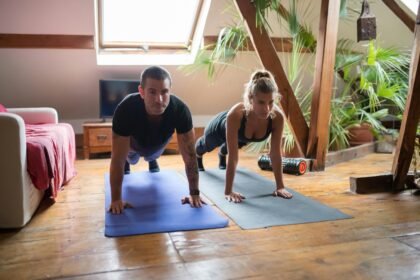





You don’t need a yoga studio, a foam roller collection, or a 45-minute wellness practice. You need 10 minutes, a patch of floor, and the willingness to admit your spine has been filing complaints for months.
- The Morning I Felt 65 Years Old at 22
- ⚙️ The Problem: Why Sitting Is a Structural Disaster
- 🔧 The Solution: Why Morning Is the Right Time for a Manual Override
- 📋 The 10-Minute Reboot Protocol: Step by Step
- Movement 1: Cat-Cow — Spinal Wake-Up Call (90 seconds)
- Movement 2: Child’s Pose — Lumbar Decompression (90 seconds)
- Movement 3: Thread the Needle — Shoulder and Thoracic Realignment (60 seconds each side)
- Movement 4: Chest Opener — Counteracting the Slump (60 seconds)
- Movement 5: Hip Flexor Stretch — The Most Critical Fix for Sitters (60 seconds each side)
- Movement 6: Wall Angels — The Humbling Posture Test (2 minutes)
- 📈 The Results Curve: What Actually Happens Over Time
- 🏁 The Lazy Verdict
- ❓ FAQs — The Ones You Were Going to Skip to Anyway
The Morning I Felt 65 Years Old at 22
I woke up on a Tuesday, swung my legs over the side of the bed, and immediately made a sound that no 22-year-old should make.
Not a groan. Not a sigh. The specific creak of someone whose neck had spent seven hours locked in whatever position the pillow decided was appropriate, whose lower back had staged a quiet overnight protest, and whose shoulders were sitting somewhere around his ears like they were bracing for an impact that never came.
I shuffled to the bathroom like a rusty hinge trying to remember what movement felt like.
This is the Laptop Hunch aftermath. And if you’ve done your 8km bike commute hunched over handlebars, spent six hours in lectures rounding your spine into a question mark, then spent four more hours at a desk finishing assignments — you know exactly what I’m describing.
The body adapts to the positions you hold most often. Spend enough time in the C-shape slump that modern student life requires, and your body starts to treat that slump as the default configuration. Muscles shorten. Joints compress. Your chest caves in. Your head migrates forward. And every morning, you wake up not as a well-rested human being but as a structural audit of everything you did wrong the day before.
The good news: 10 minutes of the right morning stretching routine for posture is enough to run a system reboot — to manually override the adaptive shortening and remind your body what “neutral” actually feels like.
The bad news: you’ve probably been skipping it.
“Your posture isn’t a personality flaw. It’s a mechanical consequence of loading the same structure in the same position for eight hours a day. Fix the mechanics. The posture follows.”
⚙️ The Problem: Why Sitting Is a Structural Disaster
Here’s what nobody explains in enough detail.
When you sit hunched over a laptop for extended periods — and in 2026, between lectures, commutes, and remote studying, most students are clocking 8 to 10 hours of seated time daily — your body does something completely logical and completely destructive: it adapts.
Muscles on the front of your body — hip flexors, chest, anterior shoulders — shorten and tighten because they’re constantly in a contracted position. Muscles on the back of your body — glutes, mid-back, rear shoulders — lengthen and weaken because they’re never required to hold tension. Your spine, which is designed to maintain a gentle S-curve, gets forced into a C-shape and starts treating that as the new baseline.
Engineers call this static loading failure. A structure held under constant uneven load without decompression will begin to deform in the direction of that load. Your spine is not exempt from this principle.
The hip flexors are the worst offenders. These muscles connect your lower spine to your femur. When they’re chronically shortened from sitting — which they will be after a full day of lectures — they pull your pelvis into an anterior tilt, which exaggerates your lower back arch, which compresses your lumbar vertebrae, which is why your lower back aches after doing nothing more strenuous than sitting in a chair.
You didn’t hurt your back. Your chair hurt your back. There’s a difference — and the fix is mechanical.
A consistent morning stretching routine for posture targets exactly this chain of adaptive shortening. You’re not trying to become flexible. You’re trying to restore baseline mechanical function before the day adds another layer of compressive load on top of yesterday’s.
🔧 The Solution: Why Morning Is the Right Time for a Manual Override
Most people think of stretching as something you do after exercise. As the cool-down. As the thing you skip because you’re already tired and it doesn’t feel like it’s doing anything.
This is exactly backwards for posture work.
Morning is when your body has just spent hours in whatever position your mattress and pillow decided was appropriate. Your spine is compressed from gravity. Your hip flexors have been in a shortened position all night. Your thoracic spine — the mid-back responsible for the rounding you see in hunched postures — has been resting in its default C-curve while you slept.
A morning stretching routine for posture is a manual override. Before the brain fully wakes up and before the day loads more static tension on top of the existing adaptive shortening, you’re running a reset sequence. You’re restoring joint mobility, decompressing the spine, reactivating the muscles responsible for upright posture, and sending your nervous system the signal that today, the default configuration is going to be different.
Ten minutes. Before your coffee finishes brewing if you time it right. And the return on that investment compounds — which brings us to the actual protocol.
📋 The 10-Minute Reboot Protocol: Step by Step
Do these in order. The sequence matters — you’re progressively moving from spinal mobility to targeted muscle release to active reactivation. Skipping around is the fitness equivalent of running a restart sequence out of order.
Movement 1: Cat-Cow — Spinal Wake-Up Call (90 seconds)
Get on all fours. Hands under shoulders, knees under hips.
Cat: Exhale and round your entire spine toward the ceiling — tuck your tailbone, pull your belly button up, drop your head. Every vertebra stacks into flexion.
Cow: Inhale and reverse it completely — drop your belly toward the floor, lift your head and tailbone, let your spine extend. Feel every segment moving.
Move slowly. One full breath per position. You’re not rushing through this. You’re lubricating every intervertebral joint in your spine, reintroducing movement to structures that have been compressed and static for eight hours.
10 full cycles. By rep 6, you’ll feel the lower back starting to release. By rep 10, your spine will remember it’s supposed to be a mobile structure, not a load-bearing column.
Movement 2: Child’s Pose — Lumbar Decompression (90 seconds)
From all fours, sink your hips back toward your heels. Arms extended forward on the floor, forehead down, spine long.
This is passive traction for your lower back. Gravity is gently pulling your lumbar vertebrae apart. The hip flexors get a mild opening. The entire posterior chain — glutes, hamstrings, lower back muscles — gets a chance to release tension that’s been building since you sat in that lecture hall yesterday.
Hold for 90 seconds. Breathe into your lower back. If your hips don’t reach your heels, put a pillow between your thighs and calves.
This is not a difficult movement. That’s the point. You’re not earning anything here. You’re just letting physics do the decompression work your spine has been requesting since approximately 2 PM yesterday.
Movement 3: Thread the Needle — Shoulder and Thoracic Realignment (60 seconds each side)
From all fours, take your right arm and slide it along the floor under your left arm, palm up, until your right shoulder and temple rest on the floor.
Your thoracic spine — the middle section that develops the characteristic hunch of the Laptop Posture — is now being gently rotated open. The shoulder capsule, which spends most of its time internally rotated from typing and phone use, gets a passive external rotation stretch.
Hold 60 seconds per side. Don’t force it. The weight of your body provides all the load needed. You are not trying to impress anyone. You are mechanically counteracting the internal rotation pattern that’s been building since you got your first smartphone.
This movement alone, done consistently, will change the way your upper back looks and feels within two weeks. The thoracic spine is where most visible postural rounding lives. Restore mobility here and you’ve addressed the root of the Laptop Hunch.
Movement 4: Chest Opener — Counteracting the Slump (60 seconds)
Stand in a doorframe. Place both forearms on the door frame at 90 degrees — elbows at shoulder height, palms flat on the frame. Step one foot forward and gently lean your chest through the opening.
You will feel this immediately. Your pectoral muscles and anterior shoulders — which have been shortened and contracted during every single hour of hunched sitting — are now being stretched under load. Your chest is opening. Your shoulders are being pulled back toward their anatomically correct position.
This is the direct mechanical counter to the slump. The slump exists because your chest is tight and your upper back is weak. The chest opener addresses half of that equation in 60 seconds.
Hold for 60 seconds. Breathe into the stretch. Don’t lean so far forward that you’re hanging off the doorframe — a gentle lean is enough. You’re stretching fascia and muscle tissue, not testing the structural integrity of your apartment.
Movement 5: Hip Flexor Stretch — The Most Critical Fix for Sitters (60 seconds each side)
Kneel on your right knee, left foot forward in a lunge position. Tuck your pelvis slightly — posteriorly rotate it, meaning tuck your tailbone under — and shift your weight gently forward until you feel a deep stretch in the front of your right hip.
This is the most important movement in this entire morning stretching routine for posture — and it’s the one most people either skip or do incorrectly.
Your hip flexors control your pelvic position, which controls your lumbar curve, which controls the load distribution through your entire spine. Chronically tight hip flexors from sitting tilt your pelvis forward, exaggerate your lower back arch, and create the compressed lumbar discs that give you that specific low-grade lower back ache that you’ve started to think of as normal.
It is not normal. It is mechanical dysfunction. And 60 seconds of loaded hip flexor stretch per side, done daily, begins to reverse it.
Hold for a full 60 seconds per side. Keep the pelvis tucked throughout — if you let the anterior tilt creep back in, you lose the stretch. Breathe steadily. Feel the front of the hip progressively releasing.
Movement 6: Wall Angels — The Humbling Posture Test (2 minutes)
Stand with your back flat against a wall. Feet about 4 inches from the baseboard. Back of your head, shoulder blades, and lower back all touching the wall. Now raise your arms to a goalpost position — elbows bent at 90 degrees, backs of your hands against the wall — and slowly slide your arms up the wall like you’re making a snow angel, trying to keep every contact point touching the wall throughout the movement.
If you can do this smoothly and without any part of your back or arms leaving the wall, your thoracic mobility is already decent.
If your lower back arches away, your elbows lift off the wall, or your hands separate from the surface before your arms are fully extended — congratulations, you’ve just diagnosed your specific postural limitations in real time.
Wall angels are simultaneously an assessment and a corrective exercise. They strengthen the lower trapezius and serratus anterior — the muscles responsible for holding your shoulder blades in proper position — while simultaneously giving you honest feedback about where your mobility restrictions actually live.
Do 10 slow repetitions. Don’t cheat the contact points. The wall doesn’t lie.
“Wall Angels are the most humbling two minutes in a morning stretching routine for posture. They will show you exactly where your laptop hours have taken their toll. Then they’ll start fixing it.”
📈 The Results Curve: What Actually Happens Over Time
After Week 1: The lower back stiffness that greets you every morning starts arriving later and leaving sooner. The specific creak of getting out of bed becomes less dramatic. You’ll notice that the hip flexor stretch, which felt like a vice grip on day one, starts to feel like an actual stretch rather than a structural complaint.
After Week 2: Your thoracic mobility improves noticeably. The Laptop Hunch starts correcting passively — meaning you’ll catch yourself sitting upright without thinking about it, because the muscles that hold that position are no longer fighting against chronically tight antagonists.
After Week 4: People may start commenting that you look different. Taller. More composed. This isn’t a compliment about your personality — it’s a mechanical observation. Your spine is now operating closer to its designed alignment. Your head is sitting over your shoulders instead of three inches in front of them. Your chest is open. Your baseline posture has been structurally reconfigured by ten minutes of daily maintenance.
This is what a consistent morning stretching routine for posture does over a month. It doesn’t require dramatic effort. It requires consistent, boring, unglamorous repetition — which is exactly how every meaningful structural change happens.
🏁 The Lazy Verdict
Ten minutes is 0.69% of your day.
You spend more time than that deciding what to watch on Netflix before giving up and watching the same show you’ve already seen. You spend more time than that standing in line for coffee before your 8km commute. You spend more time than that lying in bed after your alarm goes off, negotiating with yourself about whether you really need to get up.
A morning stretching routine for posture is the cheapest maintenance you will ever do on your body. No equipment required. No gym membership. No physiotherapy appointment — at least not yet. Just a patch of floor, ten minutes before the day starts, and the six movements above done in the order listed.
Your spine is the structural backbone — literally — of every physical thing you do. Your bike commute, your gym sessions, your ability to sit through a three-hour seminar without wanting to lie down on the floor, your sleep quality, your energy levels. All of it is downstream of how well your spinal mechanics are functioning.
Run the reboot. Every morning. Before the coffee finishes.
According to Harvard Health, regular stretching improves flexibility, increases range of motion, and can significantly reduce the risk of injury and chronic pain. This morning stretching routine isn’t complicated; it’s just 10 minutes of basic movements that reset your body before the day destroys your posture again.”
❓ FAQs — The Ones You Were Going to Skip to Anyway
Do I need a yoga mat?
No. A rug works. A carpet works. Bare floor works if you’re not doing something that puts direct pressure on a bony point. A yoga mat is nice if you have one, but it’s not a prerequisite. The floor has been facilitating stretching for longer than yoga mats have existed. Don’t let the absence of equipment become an excuse.
What if I’m as stiff as a board?
Then this routine is specifically for you, and you should expect the first week to feel uncomfortable in ways that are slightly humbling. Stiffness is just the body’s adaptation to static loading — it’s mechanical, not permanent. The movements above are designed to work within your current range of motion, not demand flexibility you don’t have yet. Go to your end range, not past it. Let the stretch develop over weeks. By week three, you’ll be surprised what has changed.
Can I do this while my coffee brews?
Yes. That is literally the point. The full routine takes 10 minutes. A standard drip coffee maker takes 6 to 8 minutes. The math works out almost perfectly for the first five movements. Finish wall angels while your mug cools to a drinkable temperature. You’ve run a full morning stretching routine for posture and you haven’t even had caffeine yet. This is efficiency.
I’ve tried stretching before and quit after three days. Why will this be different?
It won’t be different unless you attach it to something you already do every single morning without fail. Put your mat (or designated floor patch) next to your bed the night before. The moment your feet hit the floor, you’re already in position. Don’t negotiate with yourself about whether you “feel like it” — just start the first movement. By the time your brain has fully woken up and started generating excuses, you’ll already be on movement three.
What if my lower back pain gets worse with some of these movements?
Stop. Sharp or worsening pain during a stretching routine is your body filing a formal complaint that deserves to be heard. This routine is designed for postural tightness and adaptive shortening — not for acute injuries, disc problems, or nerve compression. If you have existing back issues that go beyond “I sit too much,” get a proper assessment from a physiotherapist before adding load to the system. Maintenance protocols are for functional systems, not damaged ones.