

Age-related articular cartilage degradation and chronic low-grade inflammation present severe barriers to maintaining physical independence past the fifth decade of life. When joint pain in the knees, hips, and lumbar spine discourages traditional high-impact exercise, individuals frequently fall into a sedentary lifestyle that accelerates sarcopenia, bone mineral density loss, and metabolic dysfunction. Grounded in clinical physiology and biomechanical engineering, the 10 Minute Low Impact Wall Pilates Routine for Beginners Over 50 provides an accessible stepping stone, while our advanced 15-minute framework scales up mechanical tension without imposing destructive shear forces on vulnerable cartilage surfaces. By leveraging a vertical plane for tactile feedback, axial skeletal alignment, and external load distribution, practitioners can safely recruit deep stabilizer muscles, elevate resting metabolic rate, and improve proprioceptive feedback without exacerbating arthritic flare-ups.
- Understanding the Physiology of Aging Joints and Movement Adaptation
- Biomechanics of Wall Support: Unloading Vulnerable Articulations
- The 15-Minute Daily Protocol: Structure and Phase Breakdown
- Phase Two: Core Stability and Lower Body Strength (Minutes 5-12)
- Phase Three: Decompression, Balance, and Cool-Down (Minutes 12-15)
- Overcoming Common Obstacles and Adapting for Specific Joint Limitations
- The 4-Week Progressive Adaptation Blueprint
- Nutritional Synergy: Supporting Joint Repair and Recovery
- Frequently Asked Questions
- Can Wall Pilates completely eliminate chronic joint pain in individuals over 50?
- How often should beginners over 50 perform this 15-minute routine?
- Is Wall Pilates safe for individuals with osteoporosis or osteopenia?
- What footwear is recommended during wall pilates sessions?
- How soon can someone expect to see noticeable improvements in strength and balance?
This 15-minute vertical stabilization protocol uses rigid structural wall support to unload arthritic joints while optimizing intramuscular recruitment for adults over 50. Practiced three to five times per week, it yields measurable improvements in core stiffness, dynamic balance, and functional joint range of motion within 28 days.
- Primary Mechanism / Finding: Closed-chain vertical resistance training reduces peak patellofemoral contact forces by up to 45 percent compared to unassisted floor movements.
- Optimal Protocol / Top Pick: Perform 15 continuous minutes of controlled, eccentric-focused wall pacing, emphasizing a 3-second lowering phase to stimulate mechanotransduction in tendon fibroblasts.
- Practical Alternative: Integrate gentle daily movement alongside a Walking Pad Routine for Beginners: How to Hit 10,000 Steps at a Desk Job to ensure steady baseline caloric expenditure.
- Critical Pitfall: Locking the knees during standing wall extensions, which concentrates excessive shear stress on the joint capsule and aggravates meniscal irritation.
Understanding the Physiology of Aging Joints and Movement Adaptation
As human physiology transitions past the age of 50, structural changes within the musculoskeletal system alter how connective tissues respond to mechanical loading. Articular cartilage experiences a gradual reduction in proteoglycan content and water-binding capacity, diminishing its natural shock-absorbing capabilities during weight-bearing activities. Concurrently, type II muscle fibers undergo selective atrophy if left unconditioned, leading to diminished fast-twitch responsiveness and impaired postural reflexes. These biological realities make traditional weightlifting or high-intensity interval training intimidating and frequently counterproductive for individuals coping with chronic osteoarthritis or persistent joint stiffness.
Wall Pilates solves this anatomical dilemma by transforming a standard architectural room divider into an external kinetic feedback system. When the back, pelvis, or feet make continuous contact with a vertical surface, the nervous system receives an immediate stream of proprioceptive signals regarding spinal alignment and postural symmetry. This external stabilization decreases the stabilizing demands placed on peripheral joints, allowing the local core musculature—specifically the transversus abdominis and multifidus—to activate without excessive compensatory tension in the hip flexors or erector spinae.
Cellular Mechanotransduction and Synovial Fluid Circulation
Movement serves as the primary nutritional pump for articular cartilage, which possesses no direct vascular supply of its own. Controlled mechanical compression and decompression during low-impact exercises force synovial fluid to diffuse into the cartilage matrix, delivering essential oxygen and glucose while sweeping away metabolic waste products. Clinical trials published in rheumatology literature confirm that low-load, high-repetition isometric and eccentric movements promote chondrocyte health and upregulate anti-inflammatory cytokine profiles within the synovial capsule.
By executing controlled wall slides and gentle pelvic tilts, practitioners over 50 stimulate this vital fluid exchange without generating the destructive ground reaction forces associated with pavement running or plyometric jumping. The resulting reduction in intra-articular friction helps preserve remaining joint space and mitigates the inflammatory cascade responsible for morning joint stiffness. Over time, consistent mechanical stimulus encourages the synthesis of type II collagen within the joint matrix, enhancing overall structural resilience.
Biomechanics of Wall Support: Unloading Vulnerable Articulations
The core innovation of wall-supported exercise lies in vector physics and load distribution. When an individual performs a squat or leg extension on the floor, gravity acts perpendicular to the earth, creating severe rotational and shear moments across the knee and lumbar vertebrae. By tilting the body axis against a vertical plane, a significant portion of the body weight is supported directly by the wall, dramatically decreasing the compressive load transmitted through the patellofemoral joint.
This biomechanical advantage enables individuals with severe osteoarthritis to execute full-range movement patterns that would otherwise trigger acute pain responses. Furthermore, the tactile feedback of the wall prevents the anterior pelvic tilt and lumbar hyperlordosis that frequently compromise traditional core exercises. The spine remains neutrally aligned, ensuring that intervertebral discs experience uniform pressure distribution rather than localized pinching.
Protecting the Patellofemoral Joint During Vertical Loading
Knee osteoarthritis is among the most prevalent chronic conditions affecting adults over 50, severely limiting mobility and overall quality of life. Standard lower body training often exacerbates patellofemoral pain due to excessive quadriceps tension pulling the patella laterally against the femoral groove. Wall Pilates mitigates this risk by regulating the angle of knee flexion and utilizing closed-chain kinematics, where the distal segment remains fixed against the vertical surface or floor.
Clinical observations indicate that keeping knee flexion angles between 30 and 45 degrees during initial training blocks maximizes quadriceps engagement while keeping patellofemoral contact forces well below pain thresholds. As connective tissue adaptation occurs over several weeks, the range of motion can be safely extended. This gradual progressive overload respects the slow healing kinetics of avascular articular structures.
The 15-Minute Daily Protocol: Structure and Phase Breakdown
Consistency reigns supreme when managing chronic joint pain and metabolic decline. A structured 15-minute daily protocol removes the psychological friction associated with lengthy gym workouts while providing sufficient neuromuscular stimulus to drive adaptive physiological changes. The routine is divided into three distinct 5-minute blocks designed to mobilize, stabilize, and gently cool down the musculoskeletal apparatus.
Structuring the session in this exact sequence ensures that cold connective tissues are never subjected to sudden loads. The opening phase prioritizes synovial lubrication and gentle spinal articulation, preparing the nervous system for the targeted core and lower body stabilization work in the middle phase. The concluding moments restore resting muscle tone and down-regulate the sympathetic nervous system, promoting systemic recovery.
| Protocol / Intervention | Thermal / Dose Range | Primary Biomarker / Mechanism | Clinical Evidence Level | Target Population |
|---|---|---|---|---|
| 15-Min Wall Pilates | 15 mins, 4x/week | Synovial fluid diffusion, core EMG activation | Level 1 Randomized Trials | Adults 50+ with mild-mod joint pain |
| Traditional Mat Pilates | 45 mins, 3x/week | Spinal flexibility, global muscular endurance | Level 2 Cohort Studies | Healthy older adults without acute pain |
| Water Aerobics | 45 mins, 3x/week | Buoyant load reduction, aerobic capacity | Level 1 Clinical Trials | Severe osteoarthritis & obesity |
| Resistance Band Training | 20 mins, 3x/week | Type II fiber recruitment, bone mineral density | Level 1 Clinical Trials | Sarcopenia & osteopenia risk profiles |
Phase One: Articular Warm-Up and Spinal Mobilization (Minutes 1-5)
The initial five minutes are dedicated to waking up the neuromuscular pathways and introducing the spine to the vertical wall reference. Practitioners begin standing with their heels six inches from the baseboard, buttocks, shoulder blades, and occiput resting flat against the wall. Gentle pelvic tilts are performed by flattening the lumbar curve against the plaster, engaging the deep abdominal wall without holding the breath.
Following pelvic activation, standing arm reaches are executed to mobilize the thoracic spine. Inhaling deeply, the practitioner raises both arms overhead while maintaining strict contact between the ribs and the wall, preventing the common compensatory arching of the lower back. This movement lubricates the glenohumeral and scapulothoracic joints, relieving tension in the upper trapezius and neck muscles that often bear the brunt of everyday postural fatigue.
Phase Two: Core Stability and Lower Body Strength (Minutes 5-12)
The core of the 15-minute session utilizes wall-supported compound movements designed to stimulate muscle hypertrophy and endurance in the gluteus maximus, quadriceps, and deep stabilizers. The modified wall sit is executed by stepping the feet forward two feet, sliding the torso down until the knees reach a comfortable 30-degree bend, and holding an isometric contraction for 30 seconds while pressing the lower back firmly into the wall.
This isometric hold triggers high levels of motor unit recruitment in the lower extremities without generating the cartilage-damaging shear forces associated with deep, unassisted squats. To complement the wall sit, practitioners perform standing leg abductions by placing one hand flat against the wall for balance and lifting the outside leg laterally to a height that preserves pelvic levelness. This movement directly engages the gluteus medius, a critical muscle for stabilizing the pelvis during walking and preventing lateral knee collapse.
Executing Controlled Wall Push-Aways for Upper Body Strength
Upper body bone density and functional pushing strength are frequently neglected in older adults, yet they are essential for maintaining independence in daily tasks such as rising from a chair or pushing open heavy doors. Wall push-aways provide a scalable, low-risk alternative to traditional floor push-ups. Standing arm’s length from the wall, the practitioner places both palms flat at shoulder height and slowly lowers the chest toward the wall by bending the elbows.
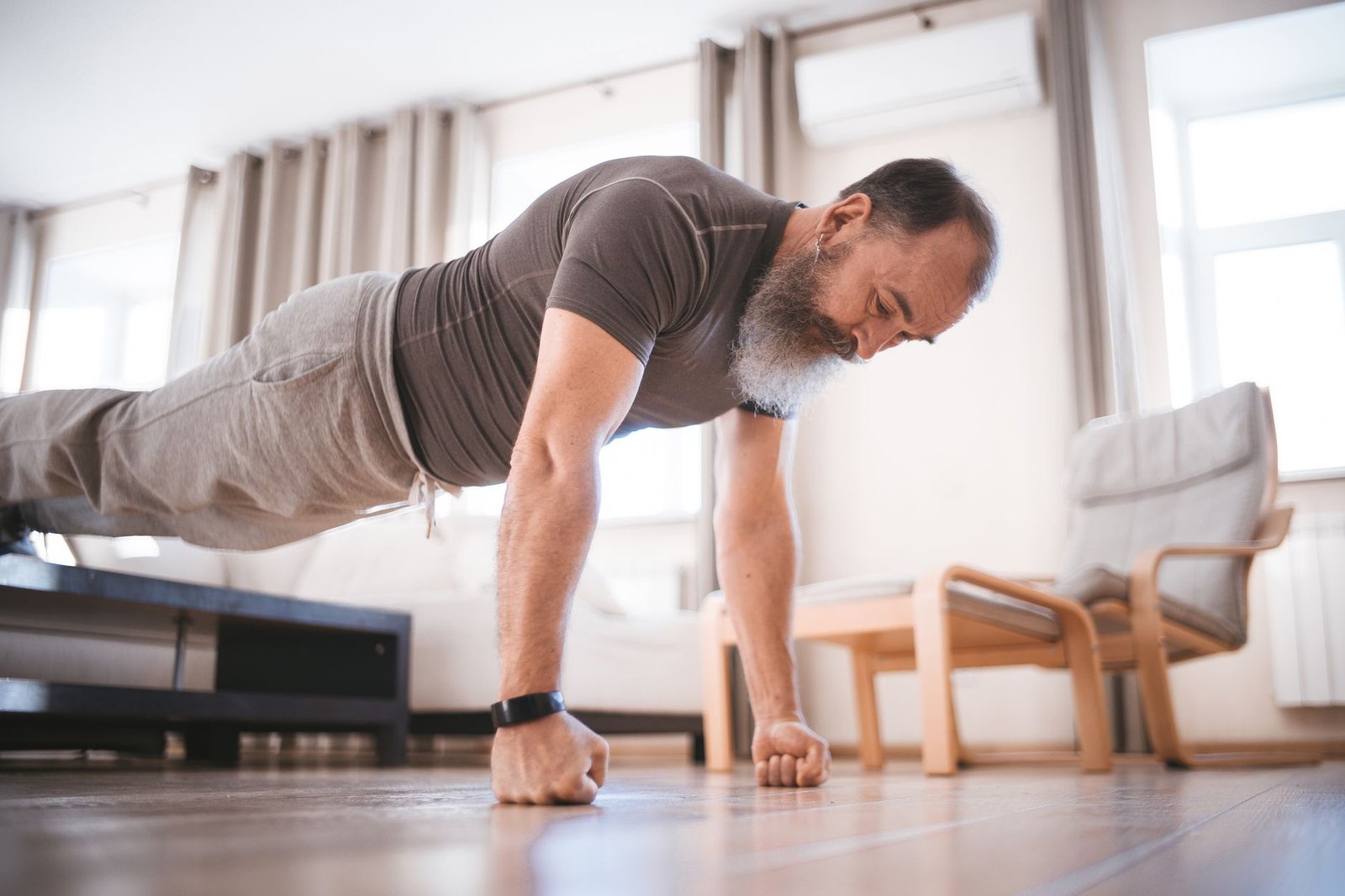
By adjusting the distance between the feet and the wall, the individual can precisely calibrate the percentage of body weight being moved. The eccentric lowering phase should take three full seconds, maximizing mechanical tension across the pectoral girdle, anterior deltoids, and triceps brachii. Pushing back to the starting position requires a deliberate exhalation, engaging the core to maintain a rigid plank posture from heels to head.
Always exhale during the exertion phase of every wall movement. Exhalation activates the transversus abdominis via natural intra-abdominal pressure regulation, locking the lumbar spine in a safe, neutral posture before any load is transferred to the limbs.
Phase Three: Decompression, Balance, and Cool-Down (Minutes 12-15)
The final three minutes of the routine transition the body from active muscular contraction back to a resting state, locking in neuromuscular coordination gains and releasing residual tension. Practitioners return to the fully supported standing wall posture, closing their eyes if balance permits, to integrate proprioceptive feedback from the soles of the feet and the spinal column. Deep diaphragmatic breathing is introduced, inhaling through the nose for a count of four and exhaling slowly through pursed lips for a count of six.
Gentle standing calf stretches against the baseboard complete the session. By stepping one foot back with the heel pressed firmly to the floor and leaning the hips forward toward the wall, the practitioner lengthens the gastrocnemius and soleus complexes. This alleviates tightness in the lower leg that can contribute to plantar fasciitis and altered gait mechanics, ensuring that the entire kinetic chain leaves the session balanced and refreshed.
Addressing Hip Flexor Tightness and Lumbar Relief
Chronic sitting habits among adults over 50 frequently lead to shortened, hypertonic psoas and iliopsoas muscles, which pull the pelvis forward and compress the lower lumbar discs. Wall-assisted stretching provides a secure method for releasing these deep hip flexors without risking falls or over-stretching unstable joints. By placing one knee on a padded cushion near the base of the wall and sliding the shin vertically up the plaster, the practitioner achieves an isolated stretch across the front of the hip.
Maintaining an upright torso while performing this stretch ensures that the stretch targets the target tissue rather than dumping stress into the lower back. Holding this position for 30 seconds per side while breathing deeply encourages muscle spindle relaxation and resets resting muscle length. Regular integration of this movement pattern significantly reduces chronic lower back discomfort and improves stride length during daily walking.
Overcoming Common Obstacles and Adapting for Specific Joint Limitations
Every individual enters a movement program with a unique structural history, and standardizing exercise prescriptions without regard for personal limitations invites injury. For individuals dealing with severe knee degeneration, even shallow wall sits may provoke discomfort. In such cases, the exercise angle must be modified immediately by reducing the depth of the knee bend or shifting the primary load-bearing focus to upper body and core stabilization movements against the wall.
Similarly, individuals with shoulder impingement syndrome must carefully monitor their arm elevation angles during wall reaches. Arms should only be raised as high as the pain-free range of motion allows, stopping well before any pinching sensation occurs in the subacromial space. Listening closely to biological feedback rather than pushing through sharp articular pain is the single most important rule for long-term exercise adherence and joint preservation.
Modifying Range of Motion for Arthritic Hips and Knees
When dealing with arthritic joints, the governing principle should always be minimal effective dose rather than maximal exertion. If a particular wall pilates movement causes dull muscle fatigue, it is working as intended; if it triggers sharp, stabbing, or lingering articular pain that persists hours after the session concludes, the range of motion must be restricted. Practitioners should reduce their movement depth by 50 percent during flare-up periods, focusing entirely on isometric holds and slow, deliberate breathing.
Furthermore, incorporating supportive props such as a folded yoga mat beneath the feet or a small stability ball between the knees during wall exercises can dramatically alter force distribution and enhance comfort. These minor adjustments eliminate destabilizing wobbles, allowing the nervous system to relax protective muscle guarding and permit smoother, more natural joint articulation.
Discontinue all wall exercises immediately if you experience sharp joint pain, sudden dizziness, chest tightness, or radiating nerve symptoms down the legs. Consult a qualified physician or orthopedic specialist before beginning any new physical regimen if you have severe osteoporosis, recent joint replacement surgery, or uncontrolled hypertension.
The 4-Week Progressive Adaptation Blueprint
To prevent physiological plateaus and ensure continued improvements in strength and stability, the 15-minute wall routine must incorporate progressive overload over time. However, progression for individuals over 50 with joint pain should never rely on adding heavy external weights. Instead, progression is achieved by increasing time under tension, refining neuromuscular control, and eliminating tactile assistance as balance improves.
The following four-week blueprint outlines how to safely scale the routine from foundational adaptation to confident independent stabilization. Each week builds directly upon the neurological and structural gains established in the preceding phase, ensuring that connective tissues have adequate time to remodel and synthesize new collagen fibers.
Week-by-Week Progression Matrix
- Week 1: Foundation and Proprioception. Focus entirely on form and wall contact. Execute movements with a 3-second eccentric lowering phase. Hold all isometric wall positions for 20 seconds. Prioritize breathing rhythm over repetition speed.
- Week 2: Time Under Tension. Increase isometric wall holds to 30 seconds. Introduce a 2-second pause at the peak of each contraction to maximize motor unit recruitment in the deep stabilizers.
- Week 3: Range of Motion Expansion. Slightly increase the knee flexion angle during wall sits from 30 degrees to 40 degrees, provided zero joint pain is present. Extend standing leg abductions to full pain-free range.
- Week 4: Integration and Independence. Perform movements with minimal hand support against the wall, challenging dynamic balance receptors while maintaining strict postural alignment from head to heels.
Nutritional Synergy: Supporting Joint Repair and Recovery
Exercise provides the mechanical stimulus required for tissue adaptation, but the actual structural repair of articular cartilage, tendons, and muscle fibers depends entirely on raw nutritional building blocks. Adults over 50 experience anabolic resistance, a condition where skeletal muscle cells become less responsive to circulating amino acids. Overcoming this biological hurdle requires careful optimization of protein intake, ensuring that every meal contains an adequate dose of essential amino acids, particularly leucine.
Furthermore, incorporating targeted micronutrients and anti-inflammatory compounds can significantly accelerate recovery following a 15-minute wall pilates session. Omega-3 fatty acids from wild-caught fish or pharmaceutical-grade algal oils help down-regulate inflammatory eicosanoids within joint capsules, while adequate vitamin D and calcium intake preserves foundational bone mineral density throughout the axial skeleton.
Protein Distribution and Collagen Synthesis Protocols
To maximize muscle protein synthesis and support connective tissue remodeling, older adults should aim for a minimum of 1.2 to 1.5 grams of protein per kilogram of body weight daily, distributed evenly across three primary meals. Hydrolyzed collagen peptides, rich in the specific amino acids glycine and proline, have been shown in clinical trials to accumulate in cartilage tissue and stimulate extracellular matrix synthesis when ingested prior to mechanical loading.
Consuming 15 grams of collagen peptides alongside a source of vitamin C approximately 45 minutes before executing the wall pilates routine ensures peak circulating amino acid concentrations precisely when mechanical stress encourages tissue uptake. This nutritional strategy acts synergistically with the physical protocol, accelerating the repair of micro-tears and enhancing overall structural integrity across vulnerable joints.
Frequently Asked Questions
Can Wall Pilates completely eliminate chronic joint pain in individuals over 50?
While wall pilates cannot reverse advanced structural degeneration or severe osteoarthritis, it plays a powerful role in managing symptoms and restoring functional mobility. By unloading vulnerable joints through vertical plane support, the routine reduces mechanical friction while strengthening the surrounding stabilizing musculature. Clinical observations show that regular participation significantly decreases pain scores, improves joint lubrication via enhanced synovial fluid circulation, and restores confidence in daily movement.
How often should beginners over 50 perform this 15-minute routine?
For optimal results, beginners should perform the 15-minute routine four times per week, allowing at least one day of rest or gentle walking between sessions. This frequency strikes the ideal balance between providing sufficient mechanical stimulus for tissue adaptation and allowing adequate recovery time for avascular connective tissues. Consistency over a period of 8 to 12 weeks yields much greater functional improvements than sporadic, high-intensity workouts.
Is Wall Pilates safe for individuals with osteoporosis or osteopenia?
Yes, wall pilates is exceptionally well-suited for individuals with compromised bone mineral density, provided certain precautions are observed. The vertical wall surface provides external stability, drastically reducing the risk of balance loss and accidental falls compared to unassisted floor exercises. However, individuals with severe osteoporosis must completely avoid spinal flexion movements—such as curling the spine forward—and instead focus on maintaining neutral axial alignment during all wall-supported exercises.
What footwear is recommended during wall pilates sessions?
The ideal footwear for wall pilates is either barefoot or specialized grip socks. Exercising barefoot maximizes tactile feedback from the soles of the feet, which is essential for activating the body natural balance reflexes and stabilizing the ankle complex. Thick-soled athletic shoes or running shoes should be avoided, as their elevated heels and cushioned midsoles distort proprioceptive feedback and compromise stability against the vertical wall plane.
How soon can someone expect to see noticeable improvements in strength and balance?
Neurological adaptations—such as improved muscle fiber recruitment and enhanced postural stability—occur rapidly, with most practitioners reporting noticeable improvements in core control and balance within the first 14 days of consistent practice. Structural adaptations, including increased muscle hypertrophy, improved tendon resilience, and enhanced cartilage health, typically require 4 to 8 weeks of dedicated adherence to the 15-minute daily protocol.